The gains at scale do not come from a better model. They come from a better division of labor between the models you already have.
Table of Contents
Start from complementary failure
Orchestration only pays off when the participants fail in different places. A diffusion image model makes photographs no code can draw, but it is metered, non-deterministic, and occasionally breaks a rule. A coding agent can reason about a task, turn a vague brief into a precise prompt, review an image against a specification, and keep exact records — but it cannot photograph anything. One supplies pixels; the other supplies judgment, memory, and control. That gap is the whole opportunity.
The conductor model
The organizing idea is simple: one agent orchestrates, the other performs a narrow, well-defined act. The primary agent sits at the center and owns everything except the pixels it cannot draw.
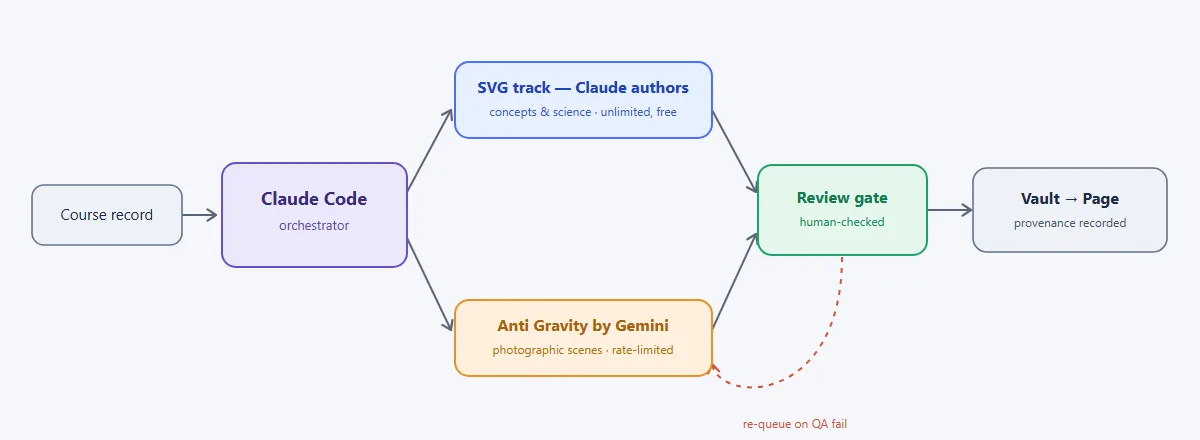
A work item enters the orchestrator, which decides how it should be made, routes it, assembles the exact prompt for the diffusion track, and takes the result back for review. Nothing ships unchecked, and nothing is forgotten, because the orchestrator — not the generator — holds the state. The same conductor pattern is not limited to images; it drives written work too, applying the identical no-API seam in generating catalog content with a local AI agent.
A fair caveat: context, not incompetence
It is tempting to call the image model “a generator without judgment,” but that is unfair and, worse, inaccurate. Anti Gravity by Gemini is a capable agentic tool in its own right. In this pipeline it is used narrowly: handed a single prompt, not the project’s documentation, standards, or history.
A model given a thin slice of context will predictably miss rules that live in the rest of it. When it renders a hand the prompt forbade, that is the signature of narrow context, not a defect in the tool. The design chooses this: the full context stays with the primary agent, and each secondary tool is called for the one thing it does best. Understood that way, the review gate is not an insult to the generator — it exists because a narrowly scoped worker cannot see the whole rulebook.
A model given a thin slice of context will miss rules that live in the rest of it — that is arrangement, not incompetence.
Pattern 1 – Route by capability
The first job of the conductor is triage: send each item to the engine built for it. Concepts and hard-science subjects go to the free vector track; photographic subjects go to the metered diffusion track. Routing well means the scarce engine is spent only where a photograph is genuinely required — never on a subject the free engine could have drawn. That one decision often separates a project measured in months from one measured in weeks.
Pattern 2 – Fill the wait
The two tracks run at wildly different speeds: the vector track is instant and unlimited, the diffusion track is metered with long cool-downs. The insight is to never let the slow lane block the fast one. Start a diffusion batch in the background and let it drain against its quota; meanwhile the orchestrator spends that same wall-clock time authoring vector images at full speed. Idle waiting is the enemy — keep both hands busy.
Pattern 3 – Delegate, then verify
Because the delegated tool works on narrow context, every image it returns passes through a review the orchestrator runs against an explicit specification: on subject, free of text, free of hands and faces, on palette, coherent with the set. Failures are re-queued with a corrected brief; only passes proceed. In one batch, the model returned an otherwise-lovely image containing a human hand despite a prompt that forbade hands. A pipeline without a gate would have shipped it. The orchestrator caught it and re-queued.
The primary agent holds the context; every other tool is called for the one thing it does best.
Pattern 4 – Cover weaknesses in both directions
The partnership runs both ways. Each engine repairs a specific gap in the other:
| Gap | Covered by |
|---|---|
| The coding agent cannot make photographs | the diffusion model supplies photographic scenes |
| The diffusion model works on a narrow prompt | the coding agent grounds and assembles that prompt |
| The diffusion model is non-deterministic and forgetful | the coding agent owns state, records, and reproducibility |
| The diffusion model has no view of quality | the coding agent reviews every output against a spec |
| The diffusion model drifts across a set | the coding agent enforces consistency and draws the consistent half itself |
Read down the right column and a shape appears: the diffusion model contributes exactly one thing — pixels a coder cannot produce — and the orchestrator contributes the rest. That is a healthy division of labor, because each side does only what it alone can.
The substrate: a shared queue, a stateless worker
Underneath the patterns is one boring, essential piece of engineering: a shared work queue with an explicit status on every item. The worker is deliberately stateless — it renders what it is told and returns pixels. All the state lives with the orchestrator. Because the worker holds none, a crashed or rate-limited run loses nothing; the orchestrator resumes the queue. Because the orchestrator holds all of it, there is one source of truth for what is done. Statelessness in the worker, authority in the conductor.
The short version
Multi-AI orchestration takes two limited systems and composes them into one capable pipeline. Give the full context and the judgment to a primary agent; call each other tool for the narrow act it does best. Route each subject to the right engine, run the metered work in the background while the free work proceeds, and review every delegated output — remembering that its misses reflect narrow context, not a bad tool. The gain is not a smarter model; it is a smarter arrangement of the ones you have.
Frequently Asked Questions
What is multi-AI orchestration?
It is a setup where one reasoning agent coordinates several tools, giving each a narrow act it performs well while the primary agent holds the context, makes the decisions, and keeps the records. The whole behaves less like a single tool and more like a small, reliable team.
Why does an image model break rules the prompt clearly forbids?
Usually because it works on narrow context — a single prompt, not the wider documentation and standards. A model that cannot see the full rulebook will miss parts of it. This is a property of how the tool is invoked, not proof that the tool is weak.
Which AI should hold the project context?
The primary agent you drive most — the one already carrying the goals, standards, and history. Secondary tools are called for specific strengths and naturally see less context, so let the primary agent ground their inputs and check their outputs.
How do you run two AI tools in parallel efficiently?
Put the metered, slow tool to work in the background and use its cool-down time for the unlimited, fast tool. The two proceed at once, so total throughput far exceeds either alone. The orchestrator’s job is to keep both busy.
Do you still need a human in an AI orchestration pipeline?
Yes, for the calls that carry cost or ship publicly. Automated review catches most failures, but a human gate on the irreversible steps is what keeps a narrowly scoped worker’s mistake from reaching production.

